

What Freshwater Fish Can Live Alone in a Tank? 6 Solitary Species
By Shawna Johnson, Owner, Purple Aquatics · Published August 17, 2026 · Updated August 25, 2026
Several freshwater species genuinely do better on their own than in company — and a few of them will actively kill anything you put in with them. But “can live alone” is where most advice on this topic quietly goes wrong, because it gets read as “needs less,” and a solitary fish tends to end up in a smaller tank with less filtration, less cover, and less attention than a community fish would get.
Key Takeaways
Six freshwater species genuinely do better alone: betta, scarlet badis, pea puffer, and paradise fish suit a true solo tank; bristlenose pleco and oscar are covered below with their own arrangement.
Shoaling species — corydoras, zebra danios, harlequin rasboras, most tetras — need groups of six or more of their own kind and should never be kept singly.
“Solo tank” (no tank mates at all) and “community single” (alone among its own species, with other species present) are different arrangements; a fish suited to one is often wasted or unsuited in the other.
Published welfare research on bettas shows tank size and enrichment measurably change swimming behavior — solitary doesn’t mean low-effort.
A solitary fish still needs a fully cycled tank, a heater, and a filter; the only real savings versus a community tank are bioload and stocking cost.
There is also a definition problem. Asking which fish can live alone can mean two completely different things, and the answers barely overlap.
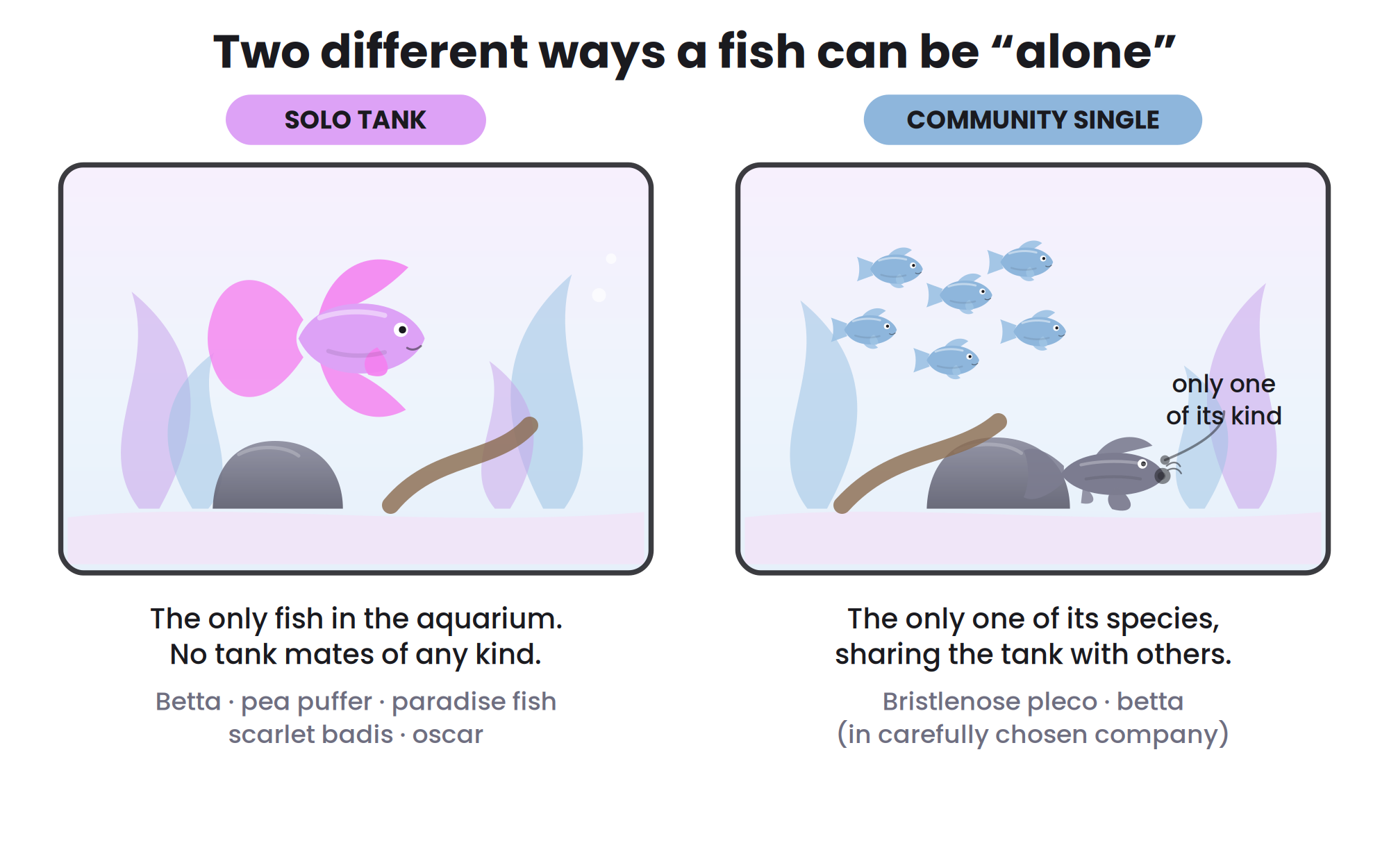
Throughout this post, two terms are used precisely. A solo tank means the fish is the only fish in the aquarium — no tank mates of any kind. A community single means the fish is the only one of its species, but shares the tank with other species. Some fish suit one and not the other. Each section below states which one it is talking about, and each species entry names which arrangement it is suited to.
What Does “Living Alone” Actually Mean for a Fish?
This section covers both arrangements.
Fish do not sort neatly into “social” and “antisocial.” What matters is the social structure a species evolved with, because that determines which behaviors it needs to be able to perform.
Shoaling, territorial, and everything in between
Shoaling and schooling species — most tetras, danios, rasboras, barbs, and corydoras — evolved in groups. Grouping gives them predator dilution, shared vigilance, and social information about where food is. Isolate one and it loses the behavioral repertoire it is built around. These fish suit neither a solo tank nor a community single.
Territorial species are the opposite. They evolved defending a patch against their own kind, and adults meeting adults means a fight. For these, another individual is not company, it is an intruder. Seriously Fish states plainly that ornamental betta strains appear more aggressive than any other Betta species, and that only a single individual can be kept per tank in most cases.
Then there is the large middle group: fish that neither shoal nor fight, and are simply indifferent to their own species outside of breeding. Many catfish sit here. They make excellent community singles and are perfectly content without a partner, but they are not candidates for a solo tank — not because they need company, but because a solo tank wastes them.
The two arrangements are not interchangeable
A solo tank is the right call for fish that would damage or eat tank mates. A community single is a stocking decision — the fish is alone only because its own kind would fight, or because a group is unnecessary. That second case is what most people asking this question actually want, and it is far easier to get right.
The mistake is assuming a fish suited to one is suited to the other. A pea puffer holds a solo tank comfortably and makes a poor community fish. A bristlenose pleco is an ideal community single and would be squandered alone.
What the research says about social isolation in fish
The short answer: the evidence is mixed. Several studies find no cortisol rise from isolation, and in one case group-housed fish had higher cortisol than isolated fish — the confident “fish get lonely” narrative outruns what’s actually been measured.
Here the hobby is more confident than the evidence is, and that is worth stating honestly.
The obvious hypothesis is that isolating a social fish is stressful, and that this should show up as elevated cortisol. Several studies looked and did not find it. One study found that zebrafish housed in groups actually had higher whole-body cortisol than individually housed fish. A 60-day isolation study found growth was unaffected and baseline cortisol was not significantly changed, though isolated fish responded differently to stressors — showing lower cortisol after a chasing stress than grouped fish, but higher cortisol after predator exposure. Others found isolated fish showed reduced anxiety-related behaviors rather than increased ones.
This does not mean fish are indifferent to company. It means cortisol is a crude instrument, group housing carries its own social stress, and the tidy story about loneliness is not established — behavioral measures often shift even when hormones do not. Two cautions on reading it: nearly all of this is zebrafish in barren laboratory tanks rather than home aquariums, and zebrafish are a shoaling species, so none of it is permission to keep shoaling fish alone.
The practical takeaway holds regardless: match the arrangement to the species’ natural social structure, and put your effort into the variables that measurably change behavior. Those turn out to be space and environmental complexity, not company.
Which 6 Freshwater Fish Can Live Alone?
Every species below is sourced for adult size, minimum tank, and parameters, and labeled for which arrangement it suits.
Betta (Betta splendens) — solo tank or careful community single · 2.4–2.8 in · 5 gal minimum · 72–86°F
Scarlet badis (Dario dario) — solo tank or species-only nano · ~1 in · 10 gal minimum · 72–79°F
Pea puffer (Carinotetraodon travancoricus) — solo tank · ~1 in · 5 gal practical floor · 72–82°F
Paradise fish (Macropodus opercularis) — solo tank · ~4 in · 20 gal minimum · tolerates unheated room temp
Bristlenose pleco (Ancistrus sp.) — community single · 4–6 in · 20–29 gal minimum · 70–79°F
Oscar (Astronotus ocellatus) — solo tank · 10–12 in or more · 75 gal minimum · 74–81°F
At a glance: the six species covered below.
Betta (Betta splendens)
Best as: a solo tank, or a carefully chosen community single
The betta is the species this question is usually about, and it is the rare case where the recommendation is backed by published research rather than accumulated opinion.
Seriously Fish does not recommend the betta for the standard community aquarium, stating that its care requirements and disposition mean it is best kept alone, and that individual fish tolerating other species is the exception rather than the norm. Fish with trailing fins or similar body shapes are the worst possible choice, because a male reads them as rivals.
Adult size: 60–70 mm standard length (roughly 2.4–2.8 inches)
Minimum tank: 5 gallons; base measurements of 45 × 30 cm for a single male
Temperature: 72–86°F (22–30°C), with 76–82°F the practical target
pH: 6.0–8.0 for ornamental strains; wild-collected fish prefer 5.0–7.0
Lifespan: 3–5 years
Two 2024 papers in Animal Welfare studied betta housing directly. In the first, males housed in 0.5 L bowls spent less time swimming than the same fish in 10, 38, and 208 L aquaria, and fish in enriched containers swam more. The authors concluded that small pet-store fishbowls suppress swimming behavior and that at least a 10 L aquarium is needed for the full expression of swimming. The second rotated 13 males through five conditions — a 1.5 L jar, 3.3 L, 5.6 L, 19.3 L, and a barren 19.3 L, and recommended a minimum of 5.6 L for retail display and sale, with larger tanks for home keeping, all containing gravel, live plants and refuges. Fish in larger tanks swam on average 92 seconds more per observation period than those in jars.
Those research floors sit below the 5-gallon hobby standard, which is worth stating rather than hiding: the studies establish where behavior measurably degrades, not an ideal.
Oldfield and Murphy’s paper — the same one behind the bowl-versus-aquaria comparison above, not Clark-Shen and colleagues’ study — closes off the obvious follow-up question. When pairs of males were housed together across 10, 38, 208 and 378 L aquaria, larger tanks produced fewer approaches and aggressive displays and more foraging — but attacks did not decrease, and the authors concluded that even very large aquaria cannot guarantee peaceful cohabitation between two males. Space reduces the displaying. It does not remove the fighting.
Practical notes: bettas need occasional access to the humid air layer above the water, so do not fill to the rim and keep the tank well covered — they are excellent jumpers. Keep flow gentle, and take care not to overfeed, as Betta species seem particularly prone to obesity.
Scarlet badis (Dario dario)
Best as: a solo tank, or a species-only nano with one male and several females
A one-inch fish with the temperament of something much larger. Seriously Fish notes that males are aggressive toward one another and command small territories. A single male in a densely planted nano tank is a legitimate and genuinely beautiful setup.
Adult size: about 1 inch
Minimum tank: 10 gallons for a single male
Temperature: 72–79°F
Origin: tributary systems draining into the Brahmaputra in West Bengal and Assam, India, typically in shallow clear streams with dense vegetation
The real difficulty is not solitude, it is diet. Scarlet badis are selective micropredators that frequently refuse dry food entirely, and they need live or frozen foods — cyclops, Daphnia, Artemia. They are also timid and slow to feed, which is a second argument for keeping them alone: in a community they lose the race to the food and quietly starve.
Pea puffer (Carinotetraodon travancoricus)
Best as: a solo tank
The pea puffer is a poor community fish for reasons that have nothing to do with sociability. Seriously Fish notes it tends to nip the fins of slow-moving or long-finned fish, that its small size means it competes badly for food against more vigorous species, and that it could easily end up eaten by larger companions.
Adult size: about 1 inch (2.5 cm)
Minimum tank: sources vary on the smallest workable footprint, but a 5-gallon planted tank is a reasonable practical floor for a single fish
Temperature: 72–82°F (22–28°C)
pH: 6.8–8.0
Hardness: 5–25°H
One honest complication: unlike other pufferfish, pea puffers are found in large groups in the wild, so a solitary one is not replicating natural conditions the way a solitary betta roughly is. Against that, Seriously Fish notes rival males have been known to fight to the death, and groups need enough space and planting to break lines of sight. Both are true: a single pea puffer is easy to keep well, and a well-executed group is closer to wild conditions. The single fish is the safer recommendation for most keepers, not the ideal one.
Diet is non-negotiable. Pea puffers should be fed small snails with the shell on regularly — their teeth grow continuously and become a problem if not ground down — plus live and frozen foods. Dried foods are not usually accepted. Plan a snail culture before you buy the fish. Habitat loss and overharvesting for the trade threaten wild populations, so captive-bred stock is the responsible choice.
Paradise fish (Macropodus opercularis)
Best as: a solo tank
One of the oldest fish in the hobby and one of the most genuinely solitary. Seriously Fish records that it was introduced to Europe in 1869, making it one of the very first ornamental fish imported.
Adult size: about 4 inches
Minimum tank: 20 gallons for a single fish, with a long footprint preferred
Temperature: tolerates a wide range including unheated room temperature, which is unusual among tropical fish
The important detail is that solitude is developmental rather than fixed. Juveniles sold in shop tanks look like a peaceful group, and buyers reasonably conclude they can be kept that way, but paradise fish grow markedly more territorial and aggressive as they mature, and a group that looked stable at the pet store rarely stays that way into adulthood.
A 2025 study on the species illustrates why researchers reach for it in the first place: paradise fish are used as a complementary model to zebrafish precisely because a fish naturally adapted to cope with challenges alone should give more consistent responses in individual-based behavioral tasks. When scientists need a fish that is genuinely fine by itself, this is the one they reach for.
Being a labyrinth fish, it needs the same surface air access and tight lid as a betta.
Bristlenose pleco (Ancistrus sp.)
Best as: a community single
The clearest example of a fish that needs no company but should not have a tank to itself. Seriously Fish describes it as relatively peaceful but territorial with its own kind and with similarly shaped species. It ignores everything that is not another pleco.
Adult size: 4–6 inches
Minimum tank: 20–29 gallons
Temperature: 70–79°F (Seriously Fish gives 21–26°C for this species; some hobby sources run a degree or two warmer)
pH: 5.5–7.5
Nitrate: keep low, as with any heavily-stocked bottom feeder
Two things people get wrong. First, this is not an algae-only fish — it is an omnivore with a plant bias and needs supplementary sinking vegetable foods and blanched vegetables. Second, driftwood is functional rather than decorative: bristlenose rasp on wood and it forms part of their diet. A bare tank with no wood is a slow welfare problem.
It is a cave spawner, with the male responsible for brood care — which is why a single male will claim a cave and defend it even with nobody to defend it against.
Oscar (Astronotus ocellatus)
Best as: a solo tank
The large-tank option, and the one most often bought by people who have not done the arithmetic. Aquarium Co-Op notes that while juveniles in the store are around 2–3 inches, adults usually reach 10–12 inches or more — the length of an American football — and can live as long as a dog.
Adult size: 10–12 inches (25–30 cm) or more
Minimum tank: 75 gallons for a single adult
Temperature: 74–81°F
Filtration: heavy — oscars are messy eaters and produce a large waste load
Oscars are predatory and will eat anything that fits in their mouths, which is what rules out a community. But they are also the strongest argument in this entire post that solitary does not mean unstimulated. Aquarium Co-Op describes them as intelligent enough to recognize their owner, coming to the front of the tank to greet you and capable of being trained to eat from your hand — and notes they can sulk at the bottom of the tank after a water change or a decor rearrangement.
A fish that notices you moved the ornaments is a fish whose environment matters. Nobody should be buying an oscar as a low-effort pet.
Which Fish Should Never Be Kept Alone?
This section is about both arrangements — these species need a group of their own kind, so neither a solo tank nor a community single is appropriate.
These get sold as singles constantly, often to people who asked a store which fish could live alone.
Goldfish. The most common victim of this question. The UFAW companion animal welfare handbook is direct: goldfish are motivated to shoal and may form schools in large ponds, and all goldfish need adequate space for shoaling, appropriate distances between individuals, and room to reach their full size potential. A common goldfish also reaches 12–14 inches and needs roughly 30 gallons per fish, so “one goldfish in a bowl” fails on both counts at once.
Corydoras catfish. A single-species group of six is the reliable minimum. A lone cory spends its time hiding instead of foraging. Note that a 2024 revision of the Corydoradinae split the group into several genera — bronze corys are now Osteogaster aenea and panda corys Hoplisoma panda — so a price tag may not match older care guides.
Zebra danios. Six or more. There is a particular irony here: danios are the species most of the social isolation research was performed on, precisely because they are so reliably social.
Harlequin rasboras. Six or more, in a 20-gallon minimum.
Bolivian rams. Frequently recommended as a solo centerpiece cichlid, and the sources disagree. Seriously Fish calls it a relatively gregarious cichlid that should ideally be maintained in a mixed-sex group of six to eight or more, given a spacious aquarium of 120 cm or longer — which is why it is on this list rather than the one above.
Most tetras, barbs, loaches and livebearers belong in this category too. If you want a fish that breeds readily and lives happily in groups, Endler livebearers are the obvious starting point.
The reliable test: if a species profile gives a minimum group size, that number is the requirement, not a suggestion.
Why “alone” so often becomes “in a tank that’s too small”
This section applies to solo tanks specifically.
This failure mode causes more harm than picking the wrong species.
One fish sounds like less fish, so it gets less tank. The logic feels sound and is wrong in a specific way: a solitary fish’s entire environment is that tank. A community fish in a bare tank at least has other fish to interact with. A solitary fish in a bare tank has nothing.
The research is consistent. Bettas in bowls swim less than bettas in tanks. Small tanks have been found to trigger stereotypic behavior and reduce boldness in zebrafish. In black rockfish, structural enrichment (rocks, shelters) measurably lowered basal stress compared to a bare tank — though plant enrichment alone actually raised cortisol higher than structural enrichment did, a reminder that not all enrichment works the same way. And in a study using a simple piece of PVC tube as enrichment, zebrafish in the enriched environment showed no significant cortisol increase after being captured and moved to a new tank, unlike the control group.
That last result is the one to hold onto. A short length of pipe measurably changed a fish’s physiological stress response to handling. Environmental complexity is not decoration.
How Do You Set Up a Tank for a Single Fish?
This section applies to solo tanks, though the enrichment and health sections apply equally to a community single.
Tank size and footprint
Start from the species profile minimum and treat it as a floor. Favor footprint over height for bottom-dwellers and territorial fish — a 20-long gives a paradise fish more usable territory than a 20-tall of identical volume.
Do not scale down because there is only one fish. The minimums quoted in this post are already for single specimens.
Cover, sightline breaks, and enrichment
This is where a solitary tank is won or lost.
Live plants, including floating species to diffuse light. Bettas fare best in a well-planted, shady tank with surface cover — tall stem plants, floating types like Salvinia or Riccia, or Cryptocoryne.
Hides with real enclosure — caves, pipe sections, upturned pots. A fish that can get out of sight spends less time hiding.
Driftwood and leaf litter. Dried leaf litter provides cover and grows microbe colonies as it decomposes, while the tannins released are considered beneficial.
Sightline breaks, which give a fish the option of choosing where to be — the substance of enrichment.
Rearrange occasionally. Novelty is stimulation, though as any oscar keeper will tell you, expect a sulk.
Filtration, heating, and cycling
One fish does not exempt a tank from the nitrogen cycle. Cycle it fully before the fish goes in, exactly as you would for a community.
Keep flow gentle for labyrinth fish and anything from still water. A sponge filter is usually the right answer. Use a heater unless the species specifically doesn’t need one, and a lid for anything that jumps — which is most of this list.
A single fish is also your entire stock, which raises the stakes on anything you add later. Plants, snails, and any future tank mate should go through quarantine first. Sourcing matters for the same reason — a single fish from a reputable breeder is a much better bet than a cheap one from a chain tank.
Signs a solitary fish is doing badly
With no other fish for comparison, problems are easier to miss. Watch for:
Clamped fins held tight against the body
Loss of appetite, or spitting food out
Faded or darkened color
Sitting on the bottom or hanging at the surface when this isn’t normal for the species
Flashing — rubbing against decor or substrate
Rapid gill movement
Flashing and rapid gilling point toward water quality or parasites first. If white spots appear, act quickly — our guide to identifying and treating ich covers the full course. Test the water before assuming a behavioral cause, because in a solitary tank the water is nearly always the variable that changed.
Frequently asked questions about freshwater fish that can live alone
-
There is no good evidence that fish experience loneliness the way people do, and the research is genuinely unsettled. Several zebrafish studies found isolated fish showed no increase in cortisol, and in at least one case group-housed fish had higher cortisol than isolated ones. What is well established is that shoaling species behave differently alone — they forage less and use less of the tank. The useful framing is not whether a fish is lonely but whether it can perform its natural behaviors, and for a shoaling species that requires a group.
-
A betta can live its whole life alone, and for most keepers that is the better arrangement. Seriously Fish advises against the standard community tank for this species. What a betta needs is space and enrichment — research found bettas in small bowls swam significantly less than in larger, planted tanks.
-
It depends on the species. A pea puffer needs a modest footprint, with 5 gallons a sensible practical floor; betta welfare research points to at least 10 litres for full swimming behavior, with 5 gallons the sensible standard. A scarlet badis needs 10 gallons, a paradise fish 20, an oscar 75.
-
No. Both are shoaling species needing groups of at least six of their own kind. A single cory hides rather than forages, and a lone danio loses the social structure it evolved with. If your tank cannot support six, choose a different species instead.
-
Somewhat, but less than expected. A lower bioload is more forgiving, but the tank still needs full cycling, a heater, a filter, and regular water changes — and a solitary fish needs more environmental enrichment, not less, because its tank is its entire world.
-
No. The UFAW companion animal welfare handbook describes goldfish as motivated to shoal and needing adequate space to do so. A common goldfish also reaches 12–14 inches and needs roughly 30 gallons per fish, so a bowl fails on size regardless.
-
Almost always yes. One fish still produces ammonia, which requires a cycled filter, and tropical species need stable heat regardless of stocking. The exceptions are narrow — paradise fish tolerate unheated tanks and goldfish are coldwater.
About the Author
Shawna Johnson is the owner of Purple Aquatics, a Boise, Idaho-based freshwater tropical fish breeding and sales business. She is an avid fish hobbyist and has been breeding her own fish since 2019.