
White Spots Aren't Always Ich: Common Freshwater Fish Conditions That Look Similar

The moment a keeper spots something white on a fish, the reflex is almost universal: it's ich. Dose the tank, raise the temperature, add salt, and wait. That reflex is understandable — ich is the most talked-about disease in the hobby, and it genuinely does cause white spots. But it is far from the only condition that does, and treating the wrong one wastes time a genuinely sick fish doesn't have, stresses a fish that never needed treatment in the first place, and in a few cases actively delays the correct response to something more serious.
This guide walks through the most common freshwater fish conditions that produce white spots that aren't ich — some harmless, some far more dangerous than ich itself — and how to actually tell them apart before reaching for a medication bottle. If you haven't already, it's worth reading our full ich identification and treatment guide first, since knowing exactly what true ich looks like is the baseline every comparison in this guide is measured against.
What True Ich Actually Looks Like

Before covering the look-alikes, it's worth being precise about the condition they're being compared to. According to UF/IFAS Extension's publication on Ichthyophthirius multifiliis, ich is a relatively large, single-celled ciliated protozoan that produces small white spots — often described as resembling grains of salt or sugar — scattered across the skin, fins, and gills of an infected fish. The parasite invades the epithelial layer of the fish's skin, encysting just beneath the surface, which is what gives each individual spot its raised, discrete appearance rather than a flat patch or smear.
A few features distinguish true ich from most of what gets mistaken for it. The spots are numerous and small, typically under a millimeter each, evenly scattered rather than clustered into a single mass. They appear relatively suddenly, often within a day or two of exposure, and progress quickly if untreated, frequently accompanied by flashing (fish scraping themselves against decor or substrate), clamped fins, and labored breathing as gill involvement increases. Ich is also highly contagious within a tank, since it reproduces directly without needing an intermediate host, and outbreaks often follow a stressful event — a temperature swing, a new fish added without quarantine, or a shipping stress episode.
Every condition below shares at least one surface feature with this picture, which is exactly what makes them worth knowing in detail.
Why So Many Conditions Get Mistaken for Ich
Ich's fame in the hobby works against accurate diagnosis in a specific way: it's the first explanation most keepers reach for, and confirmation bias does the rest. A fish with any kind of white marking gets treated as an ich case, and if the treatment happens to coincide with the actual problem resolving on its own — as several of the conditions below do — the misdiagnosis gets reinforced rather than corrected. The deeper issue is that "white and spotted" describes a symptom, not a specific pathogen, and at least half a dozen unrelated biological processes can produce a white spotted or dusted appearance on a fish's body.
Getting the diagnosis right matters most in the specific cases where the correct treatment for ich either does nothing for the actual problem, or actively works against it. A viral growth doesn't respond to anti-parasitic medication at all. A fish with breeding tubercles doesn't have a disease to treat in the first place. And a fish with velvet — arguably the most dangerous look-alike on this list — needs faster, more aggressive intervention than standard ich protocol calls for, not the same approach applied a day or two late.
Velvet Disease: Gold Dust That Isn't Ich

Velvet, caused by the freshwater dinoflagellate parasite Piscinoodinium pillulare, is the look-alike most likely to be confused with ich under casual observation — and the one where that confusion carries the most risk. Rather than discrete white dots, velvet produces a fine, dust-like coating across the fish's skin that often has a golden, rust, or greenish sheen under angled light, which is where the disease gets its common name, gold dust disease. Under standard aquarium lighting from directly above, this dusting can be nearly invisible, and the classic diagnostic trick — turning off the room lights and shining a flashlight across the fish's body at a low angle — is often the only reliable way to see it clearly before the infection is well advanced.
Velvet behaves more aggressively than ich in several ways that make the distinction genuinely urgent. The parasite is partly photosynthetic, meaning it can sustain itself with light energy even off a host for periods of time, and it disproportionately targets gill tissue early in the infection, which means fish can show labored breathing and gasping at the surface before any visible dusting appears on the skin at all. Affected fish typically show heavy flashing, clamped fins, rapid gill movement, and appetite loss, and because the disease can progress from first visible symptoms to serious gill damage faster than typical ich, delaying treatment while assuming it's ordinary ich carries real risk.
Bettas, gouramis, and small tetras and killifish tend to be hit hardest by freshwater velvet, and outbreaks trace back overwhelmingly to new fish introduced without a quarantine period. If you're stocking betta fish or other velvet-susceptible species, a dedicated quarantine period with a flashlight check specifically for this fine dusting — not just a visual scan for obvious white spots — is worth building into the process, since velvet's early presentation is subtle enough to slip past a standard once-over.
Lymphocystis: Cauliflower Growths Mistaken for Early Ich
Lymphocystis is caused by a completely different category of pathogen than either ich or velvet: an iridovirus known as Lymphocystivirus. According to UF/IFAS Extension's publication on the disease, infection results in pebble- or wart-like nodules that most commonly appear on the fins, skin, or gills, and in their earliest stage, small emerging nodules genuinely can resemble the discrete white dots of early ich closely enough to cause real confusion.
The distinguishing feature is growth pattern over time rather than appearance at a single moment. Ich spots stay roughly the same size and simply increase in number as the infection spreads. Lymphocystis nodules do the opposite: individual growths enlarge over days to weeks, eventually clumping together into the rough, irregular, cauliflower-like mass the condition is commonly named for. A grouping of small white bumps that hasn't changed in number but has visibly grown larger and lumpier over several days is behaving like lymphocystis, not ich.
There is no cure for lymphocystis, because antiviral treatment isn't a practical option for home aquarists, and unlike ich, this isn't actually a problem — most cases resolve entirely on their own over the course of weeks to a few months as the fish's immune system clears the virus, provided water quality stays high and the fish continues eating well. This is precisely the scenario where misdiagnosing lymphocystis as ich causes real harm: dosing a fish with ich medication does nothing to help a viral growth, adds unnecessary chemical stress to a fish whose immune system is already doing the actual work of resolving the condition, and in fish sensitive to certain ich treatments, can make recovery slower rather than faster. The correct response to genuine lymphocystis is supportive care — excellent water quality, a varied and vitamin-rich diet, and patience — not medication.
Trichodina and Other Ciliates: The Ich Look-Alikes Under the Microscope
A handful of other ciliated protozoans produce symptoms that overlap meaningfully with ich without producing the same discrete white-spot appearance, and Trichodina is the most common of these in freshwater tanks. According to the Merck Veterinary Manual's reference on parasitic diseases of fish, Trichodina and related genera infect the gills, skin, and fins across virtually all freshwater species, producing high respiration rate, excess mucus production, flashing, and general loss of condition — a symptom list that overlaps heavily with ich's early presentation, minus the discrete white dots.
What differentiates a Trichodina infestation in practice is the absence of visible spots paired with the presence of a general dulling or excess sliminess to the fish's skin, sometimes visible as a faint gray or hazy cast over the body rather than distinct marks. Because Trichodina and similar ciliates require microscopic examination for definitive diagnosis, a home aquarist typically can't confirm the specific organism responsible — but ruling out true ich by the absence of countable white spots, combined with these more generalized symptoms, points toward this broader category of protozoan parasite rather than Ichthyophthirius specifically. Treatment approaches overlap significantly with ich treatment in practice, which somewhat lowers the stakes of a precise diagnosis here compared to velvet or lymphocystis, but recognizing that "flashing and excess mucus without spots" isn't necessarily early-stage ich prevents a keeper from waiting for spots to appear before treating at all.
Columnaris and Fungal Infections: White Patches, Not White Dots
Columnaris, caused by the bacterium Flavobacterium columnare, and true fungal infections such as Saprolegnia both produce white or grayish-white material on a fish's body that gets mistaken for ich more often than the underlying biology would suggest, largely because both conditions are commonly nicknamed with words like "cotton" or "fungus" that evoke a similarly pale, textured appearance.
The distinction from ich is usually straightforward once a keeper knows to look for it: both columnaris and fungal infections present as patches or clusters rather than individually countable spots, often with a cottony or fuzzy texture rather than the smooth, discrete dots ich produces. Columnaris in particular frequently shows a distinctive pale band encircling the body near the dorsal fin, sometimes called a saddleback lesion, which has no equivalent presentation in an ich infection. Columnaris can also progress dramatically faster than ich, visibly worsening within 24 to 48 hours in some cases, which is itself a useful differentiator, since ich typically spreads across a fish and a tank over a longer, more gradual timeline.
Treating a columnaris or fungal case as ich is a meaningful misstep because the treatments don't overlap. Ich medications target a protozoan parasite; columnaris needs an antibacterial approach, and true fungal infections need an antifungal one. A patch of white, cottony material that isn't responding to a week of standard ich treatment is worth reconsidering as one of these instead, particularly if it's clustered in one area rather than scattered as individual dots across the body.
Breeding Tubercles: Harmless White Bumps Mistaken for Disease
Not every white spot is a symptom of anything at all. Many cyprinid species — danios, goldfish, and various minnows among the most commonly kept — develop small, hard white bumps called breeding tubercles on the gill covers, pectoral fins, and sometimes the head during breeding condition, particularly in mature males. These tubercles are a completely normal secondary sex characteristic, comparable to antlers or breeding coloration in other animal groups, and they carry no disease significance whatsoever.
The confusion with ich happens because tubercles are, at a glance, small white raised bumps on a fish's body — checking every box a worried keeper is scanning for. The differences become clear on closer inspection: tubercles are typically concentrated on the gill covers and leading fin rays rather than scattered evenly across the body, they feel distinctly hard and rough rather than soft, they appear only on sexually mature fish (predominantly males) and specifically during breeding condition, and critically, they never progress, spread to other fish, or come with any of ich's accompanying symptoms like flashing or clamped fins. A fish that's otherwise behaving completely normally, eating well, and showing small hard bumps concentrated on the gill covers rather than the whole body almost certainly doesn't have ich, or anything else that needs treating.
Salt Creep, Mineral Deposits, and Water Spots: Not a Fish Problem at All
Occasionally what looks like a white spot isn't on the fish at all. Hard water mineral deposits, sometimes called salt creep when they form at the waterline or on equipment, can leave a white, crusty residue on glass, decor, and even briefly on a fish's body right after handling or a water change in hard tap water, especially as droplets evaporate and leave mineral residue behind. This is a water chemistry artifact, not a biological condition, and it wipes away or dissolves rather than persisting on the fish's skin the way an actual parasite or growth would.
This look-alike is easy to rule out: gently observe the fish in clean water a few minutes after any handling or water change, away from any surface where water has recently evaporated, and confirm whether the marking is actually attached to the fish's body or was simply residue from the water itself. It's a low-stakes mistake compared to the others on this list, but it's a genuinely common source of a panicked "is this ich" moment that resolves itself the moment the fish is observed under normal conditions.
Milky or Slime Coat Disease: A Cloudy Coating Mistaken for Ich Dust
A fish producing visibly excess mucus, sometimes described as a milky or hazy film across the body, can be confused with the fine dusting of early velvet or the general cloudiness sometimes associated with a heavy protozoan load. This excess slime coat production is usually a generalized stress response — to poor water quality, handling, aggressive tankmates, or an underlying parasitic or bacterial irritant — rather than a specific disease in its own right, which makes it more of a symptom category than a single condition to diagnose and treat.
The key differentiator from both ich and velvet is texture and distribution: slime coat overproduction looks like a uniform, somewhat glossy or hazy sheen over the entire body rather than discrete spots or a fine, dusty, matte coating. It's also frequently accompanied by other stress indicators — clamped fins, reduced activity, color loss — that point toward a water quality or handling-related root cause. Testing ammonia, nitrite, and nitrate is a more useful first step here than reaching for an anti-parasitic medication, since correcting the underlying stressor often resolves the excess mucus production without any targeted treatment at all.
Air Bubbles Under the Skin: Gas Bubble Disease
Less common but worth ruling out, gas bubble disease occurs when water becomes supersaturated with dissolved gas — most often from a cracked intake line pulling in air on the suction side of a pump, or occasionally from a rapid temperature increase releasing dissolved gas faster than it can escape. The result can be small, visible bubbles trapped just under a fish's skin or in the fins, which at a glance can resemble a cluster of small white or translucent spots.
The tell here is usually location and consistency: gas bubbles tend to appear as slightly raised, translucent or silvery bumps rather than opaque white dots, and they're often concentrated in the fins or around the eyes rather than distributed evenly across the body the way ich is. This is a plumbing and equipment issue rather than a disease, and the fix is mechanical — checking intake lines for air leaks and confirming no equipment is aerating water more aggressively than intended — rather than medicinal.
Scarring, Healing Wounds, and Old Injury Marks
A fish recovering from a physical injury, a healed parasite bite, or even a resolved case of true ich can be left with small pale or white scar tissue at the injury site as it heals. This is sometimes mistaken for a new or ongoing infection, particularly by a keeper who's already anxious about disease after a recent scare.
Scar tissue is distinguished by its stability: it doesn't grow, spread, multiply, or come with any of the behavioral symptoms — flashing, clamped fins, appetite loss — that would accompany an active infection. A single, unchanging pale mark at a known injury site, on a fish that is otherwise eating and behaving normally, is far more likely to be a healing mark than a new problem, and repeatedly medicating a fish for a scar that was never going to resolve into anything else adds stress without any benefit.
A Side-by-Side Comparison: How to Actually Tell Them Apart

Pulling the distinguishing features together into a single comparison makes the differences easier to apply at the tank:
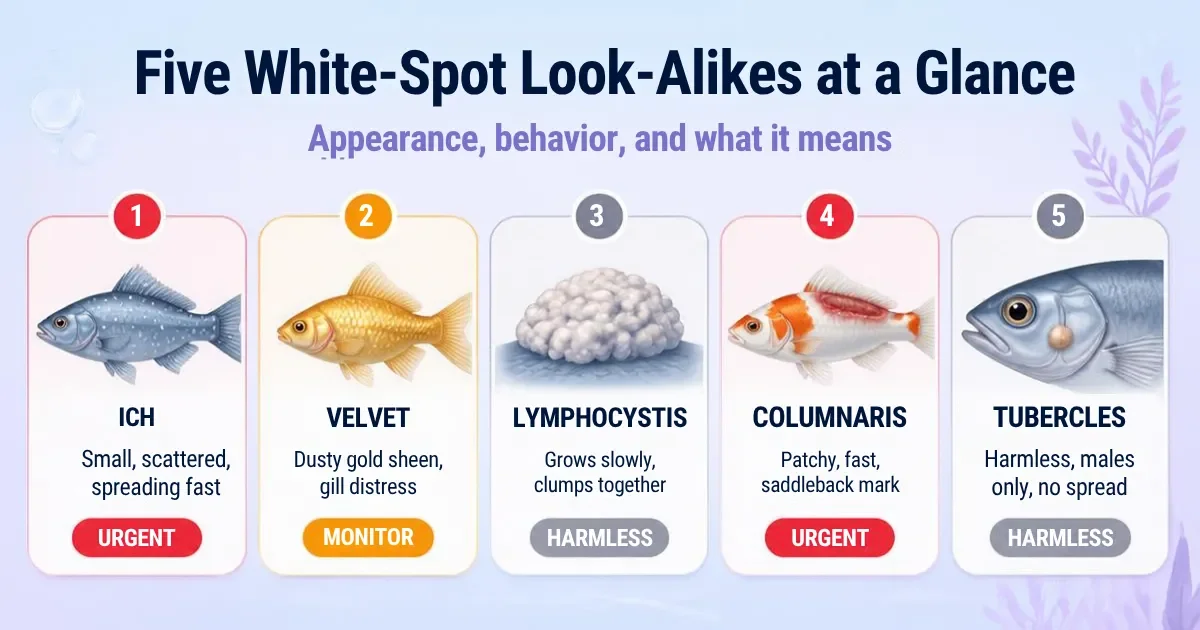
True ich produces numerous small, discrete white spots scattered evenly across the body, appearing over a day or two and progressing steadily, typically with flashing and clamped fins.
Velvet produces a fine, dust-like golden or rust sheen best seen with a flashlight at an angle in a darkened room, often with early and severe gill involvement and rapid breathing.
Lymphocystis produces wart-like or cauliflower-like nodules that start small but visibly enlarge and clump together over days to weeks, without the accompanying flashing or breathing distress ich or velvet cause.
Trichodina and related ciliates produce flashing, excess mucus, and a general hazy or dulled appearance without discrete countable spots.
Columnaris and fungal infections produce cottony white or grayish patches and clusters, sometimes with a saddleback band, that can progress within 24 to 48 hours.
Breeding tubercles appear as small, hard, rough white bumps concentrated on the gill covers and leading fin rays of mature males, with no spread, no progression, and no accompanying symptoms.
Salt creep and mineral residue rinse or wipe away and aren't actually attached to the fish's body once observed in clean water.
Slime coat overproduction presents as a uniform hazy or glossy sheen across the whole body rather than spots, usually alongside other stress signals.
Gas bubble disease produces translucent or silvery raised bumps, often concentrated in the fins or near the eyes, tied to an equipment or water chemistry cause rather than a pathogen.
Why Getting the Diagnosis Right Matters So Much
The cost of misdiagnosishow to tell if your guppy is pregnant isn't uniform across this list, and understanding where the real stakes are helps prioritize which distinctions matter most in an actual emergency. Mistaking breeding tubercles, salt creep, or a healed scar for ich costs nothing more than an unnecessary round of medication and some avoidable stress on a fish that was never sick. Mistaking lymphocystis for ich is similarly low-stakes in terms of fish health, though it means treating a self-resolving condition as if it needs intervention it doesn't.
The more serious risk sits with velvet and columnaris specifically. Both can progress faster than ich, and both need a different, often more urgent treatment approach than standard ich protocol. Time spent treating either one as ordinary ich — waiting the standard week to see if a copper or formalin-based ich treatment takes effect — is time that a fast-moving velvet or columnaris infection doesn't offer. This is the single most important reason to actually confirm what's causing a white marking before treating on autopilot, rather than defaulting to the most familiar diagnosis because it's the one every hobbyist has heard of first.
How to Properly Diagnose Before Treating
A short, deliberate diagnostic pass before reaching for medication resolves most of the confusion covered in this guide. Start with a flashlight check in a darkened room, looking specifically for the fine golden or rust dusting that indicates velvet rather than assuming any pale coating is ich or slime coat stress. Count and describe the marks: are they numerous, small, and evenly scattered (ich), clustered and enlarging over days (lymphocystis), or concentrated on the gill covers and fin rays of a mature male with no spread (breeding tubercles)?
Watch behavior alongside appearance. Flashing, clamped fins, and labored breathing point toward an active parasitic or bacterial process — ich, velvet, Trichodina, or columnaris. A fish behaving completely normally despite visible white marks points toward tubercles, scar tissue, or a resolving lymphocystis case. Check the timeline: has the marking appeared and worsened within a day or two (ich, columnaris), grown slowly over a week or more (lymphocystis), or stayed completely unchanged since it was first noticed (tubercles, scarring)?
If a case doesn't clearly fit any of these patterns, or if a fish is showing labored breathing and rapid decline that outpaces what standard ich would explain, treating for velvet or columnaris as a precaution — both of which move faster and carry higher stakes than ich itself — is generally the safer default than waiting for a more certain diagnosis. And any new fish showing anything on this list, from the moment it's added, is exactly the scenario quarantine exists for — our full guide to quarantining freshwater fish covers the setup and observation window needed to catch and correctly identify a developing issue before it reaches a display tank at all.
Prevention: Reducing the Risk of All of These at Once
Most of the genuinely pathogenic conditions on this list — ich, velvet, Trichodina, columnaris, and to a lesser extent lymphocystis — share the same underlying risk factors: new fish introduced without quarantine, sudden water quality or temperature swings, and general stress from overcrowding or poor husbandry. A consistent quarantine period for every new arrival, Endler livebearers and guppies included despite their reputation as hardy fish, catches the overwhelming majority of these conditions while they're still isolated and far easier to treat or simply observe through resolution.
Stable water parameters and a gradual approach to any necessary temperature adjustment reduce the stress that triggers outbreaks of opportunistic conditions in fish that may already be carrying a low-level parasite load without symptoms. And for species particularly prone to specific look-alikes on this list — bettas and gouramis for velvet, algae-eating catfish and plecos for a range of skin and gill parasites given their scaleless or lightly armored bodies — a slightly more cautious quarantine and observation period is worth the extra patience relative to hardier community species.
A Practical Checklist for Diagnosing a White-Spotted Fish
Turn off the room lights and check with a flashlight at a low angle for the fine golden or rust dusting characteristic of velvet, before assuming any white marking is ich
Count and describe the marks — numerous small even spots suggest ich; clustered, enlarging bumps suggest lymphocystis; hard bumps on the gill covers of a mature male suggest breeding tubercles
Watch for flashing, clamped fins, and labored breathing, which point toward an active parasitic or bacterial process rather than a harmless or self-resolving condition
Check the timeline of the marking — sudden appearance and rapid spread over a day or two points toward ich or columnaris; slow growth over a week or more points toward lymphocystis; no change at all points toward tubercles or scarring
Confirm the marking is actually on the fish, not water residue, by observing in clean water away from any recent evaporation or handling
Rule out equipment issues such as a cracked intake line if bumps appear translucent or silvery and concentrated in the fins or around the eyes
Treat suspected velvet or columnaris cases with urgency given their faster progression, rather than waiting out a standard ich treatment window first
Quarantine every new fish and observe closely during that period, since most of these conditions are far easier to correctly identify and manage while a fish is isolated
Frequently Asked Questions About White Spots That Aren't Ich
-
A flashlight and a darkened room are usually enough. Velvet produces a fine, dust-like golden or rust sheen best seen at an angle, while ich produces distinct, countable white dots visible under normal lighting.
-
Lymphocystis is rarely fatal and usually resolves on its own over several weeks to a few months with good water quality and diet. It can occasionally interfere with feeding or swimming if growths become very large or are positioned near the mouth or gills, which is worth monitoring even though the underlying virus itself has no direct treatment.
-
If the bumps are hard, concentrated on the gill covers or leading fin rays, and the fish is a mature male behaving and eating normally, this is very likely breeding tubercles rather than any disease, and needs no treatment.
-
It depends on what you've ruled out. If velvet or columnaris are genuine possibilities given the appearance and speed of onset, treating quickly matters more than certainty, since both can progress faster than ich. If the marking is stable, unchanging, and the fish is behaving normally, medicating "just in case" adds unnecessary stress without clear benefit.
-
White spots not responding to a properly dosed ich treatment over the recommended course are a strong signal the underlying cause isn't actually ich — lymphocystis, breeding tubercles, and columnaris are all common explanations for treatment-resistant white marks, since none of them respond to standard anti-parasitic ich medication.
-
Ich, velvet, Trichodina, columnaris, and lymphocystis can all spread between fish, though at different rates and through different mechanisms. Breeding tubercles, scar tissue, salt creep, and gas bubble disease are not contagious, since they aren't caused by a transmissible pathogen at all.
-
Yes. Isolating an uncertain case protects the rest of the tank regardless of the final diagnosis, and gives a much clearer, less distracting environment to observe how the condition actually progresses before deciding on treatment.