

What Fish Should I Get for My First Tank? The Best Beginner Tropical Fish
The honest answer to “what fish should I get for my first tank?” depends less on the fish than on the tank you put them in. Almost every species sold as a beginner fish will do well in a properly sized, properly cycled aquarium, and almost every one of them will struggle in a five-gallon bowl that was filled with tap water yesterday afternoon. The species list matters. The setup matters more.
What follows is a ranking of eight beginner tropical fish ordered by how forgiving they genuinely are — not by how often they appear on beginner lists. Two of the most popular fish in the hobby land in the lower half, and the reasons are specific rather than snobbish. Alongside the ranking you will find the tank sizes, water parameters, and group sizes each species actually needs, complete stocking plans for five common tank sizes, and the handful of fish that cause more first-year failures than any others.
What actually makes a fish beginner-friendly
“Hardy” is used loosely in the hobby, and it hides three separate qualities that a first-time keeper should evaluate independently.
The first is physiological tolerance — how wide a range of temperature, pH, and hardness a species handles without stress. Zebra danios sit at one extreme, comfortable anywhere from the mid 60s to the upper 70s Fahrenheit (Seriously Fish gives 18–25°C, or roughly 64–77°F). Cardinal tetras sit closer to the other, doing best in soft, warm, acidic water that most tap supplies do not naturally provide.
The second is disease resistance, which is a property of the individual fish and its origin as much as of the species. A guppy from a crowded overseas farm and a guppy from a local breeder are the same species with meaningfully different odds of surviving their first month with you.
The third is care simplicity: how much a species needs in the way of tank size, group numbers, specialized food, and territory. A common pleco is physiologically tough and disease-resistant, and it is still a terrible first fish, because an eighteen-inch adult in a twenty-gallon tank is a welfare problem no amount of hardiness solves.
A genuinely beginner-friendly fish scores well on all three. And underneath all three sits the same foundation: stable, low-nitrogen water. Fish do not die of “beginner mistakes” in the abstract — they die of ammonia, nitrite, and swings in temperature, which is why improving your aquarium water quality does more for survival rates than any species choice on this list.
Start with the tank, not the fish
The single most common first-tank mistake is buying the smallest aquarium that will fit the fish, on the theory that a small tank is easier to manage. The opposite is true, and the reason is dilution.
Every fish produces ammonia continuously. In a large volume of water, a given amount of ammonia is diluted to a low concentration and the biological filter has time to process it. In a small volume, the same amount produces a much higher concentration, much faster. Water temperature behaves the same way — five gallons tracks room temperature closely, while twenty-nine gallons of water has enough thermal mass to ride out an evening when the heat goes off. A small tank punishes small mistakes; a large tank absorbs them.
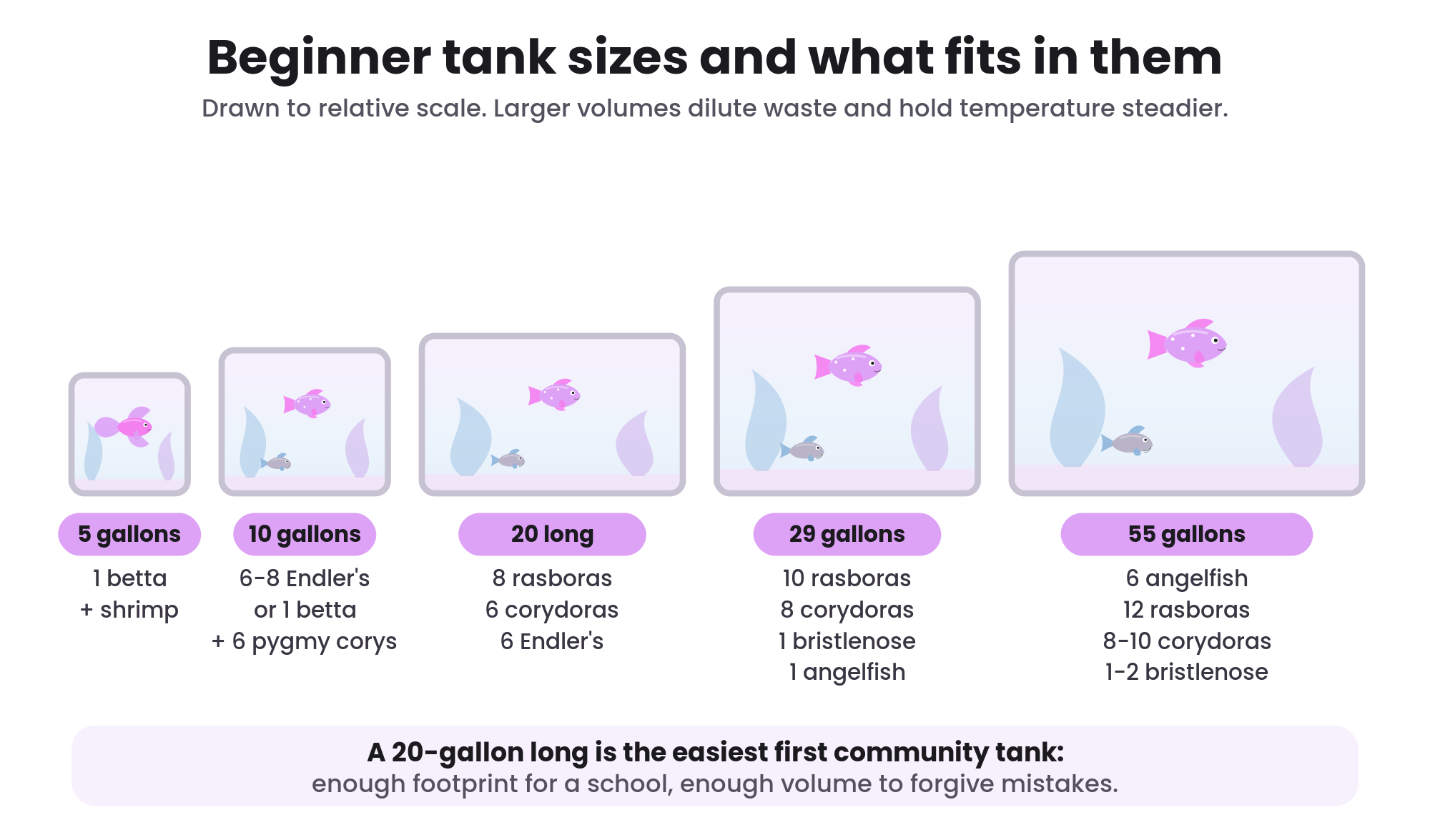
For a first community aquarium, a 20-gallon long is the size that changes the experience most. It has the footprint for a school of small fish, enough volume to be forgiving, and it fits on furniture most people already own. A 10-gallon works for a nano setup built deliberately around small species. A 29-gallon or 55-gallon opens up centerpiece fish and is easier again, at the cost of space and a heavier filter.
The equipment a first tank actually needs
A heater rated for your tank volume. Tropical fish need stable heat; unheated room-temperature water swings several degrees a day and suppresses the immune system.
A thermometer you actually read, not just a heater dial. Heater thermostats drift.
A filter — a sponge filter driven by an air pump, or a hang-on-back unit. The filter’s real job is housing bacteria, not polishing the water.
A liquid test kit that reads ammonia, nitrite, nitrate, and pH. Test strips are convenient and generally regarded as less accurate for ammonia and nitrite, which are the two readings that matter most in the first months. If you use strips, treat any non-zero ammonia or nitrite reading as a prompt to confirm with a liquid test.
A dechlorinator, because chlorine and chloramine in tap water kill the bacteria your filter depends on.
A gravel vacuum and a bucket used only for the aquarium.
Cycle the tank before you buy a single fish
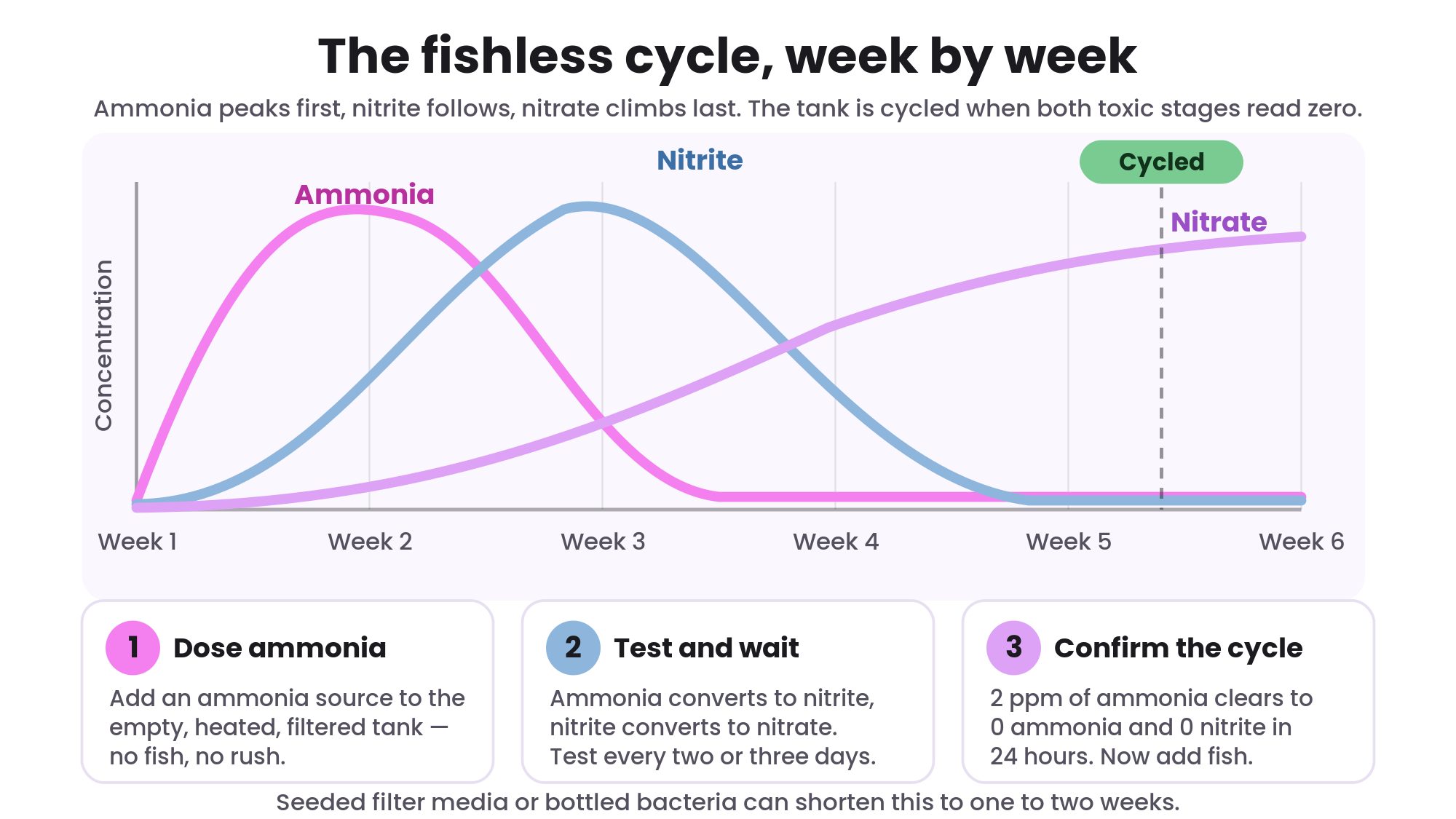
The nitrogen cycle is the one piece of theory that a beginner cannot skip, because nearly every early die-off traces back to it. Fish excrete ammonia, which is acutely toxic. One group of bacteria converts ammonia into nitrite, which is also toxic. A second group converts nitrite into nitrate, which is far less harmful and is removed by water changes and taken up by live plants. Establishing those bacterial colonies is what “cycling” means.
In a fishless cycle you dose an ammonia source into the empty tank and test until the tank can clear about 2 ppm of ammonia, with both ammonia and nitrite reading below roughly 0.2 ppm the next day. That is Dr. Tim’s published completion test, and the 2 ppm figure comes from the same protocol — four drops of their ammonium chloride solution per gallon.
How long this takes varies more than most beginner guides admit. Four to six weeks from scratch is the figure usually quoted and a reasonable expectation, but Aquarium Co-Op puts the range at a few weeks to months, and Dr. Tim’s own material declines to give a fixed window because water chemistry, temperature, and bacterial source all move it. Seeded filter media from an established aquarium or a quality bottled bacteria product commonly shortens it to one to two weeks. Nitrate appearing while ammonia and nitrite stay at the floor of your test kit is the signal you are waiting for.
The alternative, adding a few “hardy starter fish” and letting them cycle the tank, is still widely recommended and is worth being clear about: it works in the sense that the bacteria establish, and it works by exposing living fish to ammonia and nitrite for several weeks. Ammonia and nitrite exposure is well documented to damage gill tissue, and fish that survive a fish-in cycle can carry that damage. There is no species on this list tough enough to make that a good plan, and fishless cycling costs nothing but patience.
If you have already bought fish before reading this, you are doing a fish-in cycle whether you meant to or not. Test daily and change 25 to 50 percent of the water any time ammonia or nitrite reads above 0.25 ppm. It is more work than the fishless route, and it is recoverable.
The 8 best beginner tropical fish, ranked
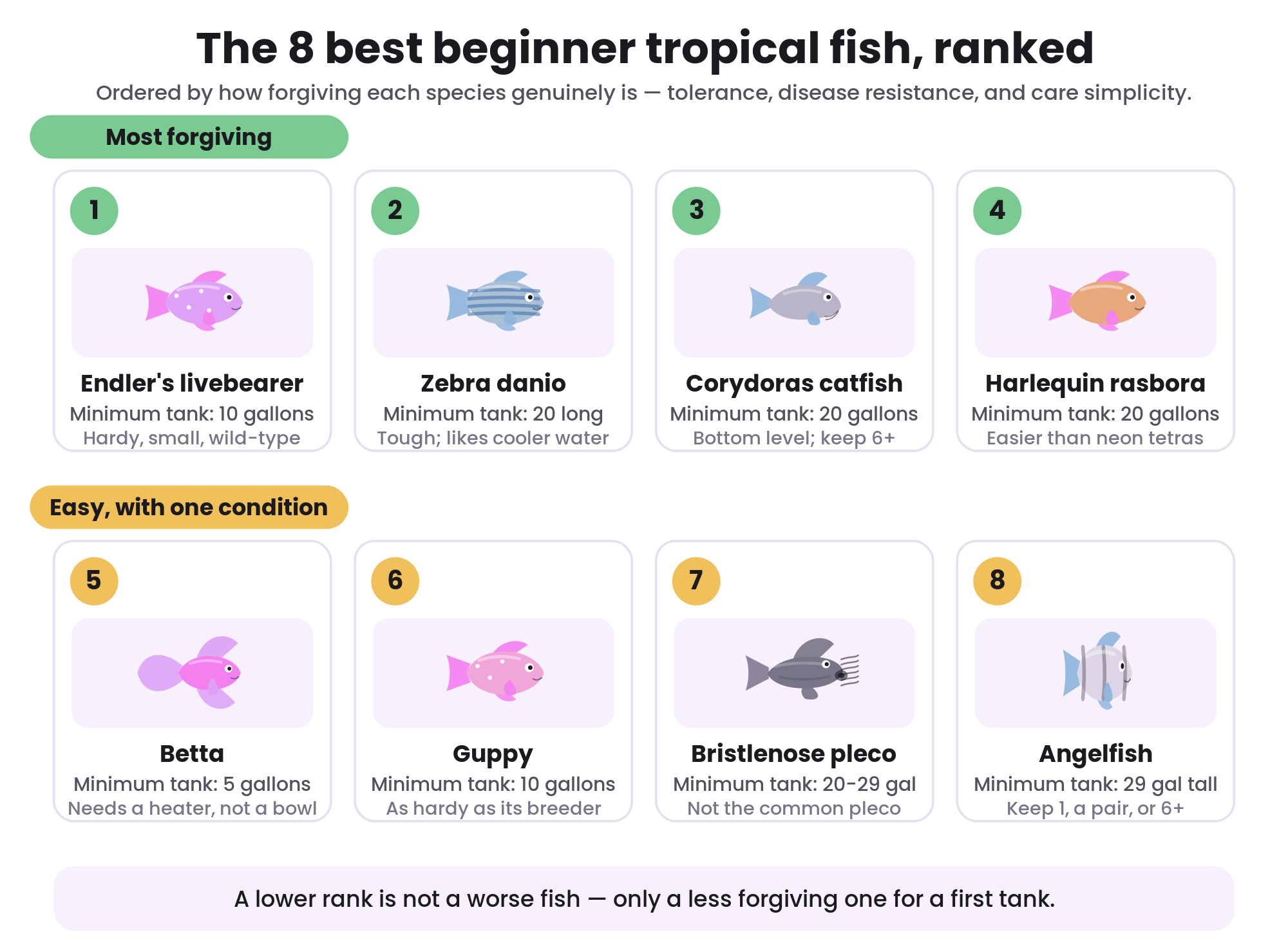
This ranking weighs the three qualities above together. A fish placing lower is not a bad fish — several of the lower entries are among the most rewarding animals in the hobby. They are simply less forgiving of a first-timer’s first tank.
Endler’s livebearer (Poecilia wingei)
Endler’s livebearers are the closest thing to an ideal first tropical fish. Males top out around an inch and females around 1.8 inches, so a trio sits comfortably in a 10-gallon aquarium and a full colony wants a 20. Their appeal for a beginner is mostly a matter of size and tolerance: they stay small, they eat anything, and both of the sources this post leans on put their tolerances wide — Aquarium Co-Op reports pH from 6.5 to 8.5 and “almost any water hardness,” Seriously Fish gives pH 7.0–8.5 and 15–35°H. These are not fish whose water chemistry you have to engineer.
One caveat on genetics, because it is often stated too confidently. Pure, wild-type Endler strains do exist and are maintained by hobbyist breeders, but Seriously Fish notes that Endlers and guppies are proven to hybridise and produce fertile offspring, and Aquarium Co-Op’s Endler care guide lists named Endler-guppy hybrids — black bar, tiger, cobra, El Silverado, lime green — among the common varieties sold under the Endler’s name. “Endler’s” on a retail tank is therefore not by itself a guarantee of wild-type stock. Aquarium Co-Op’s article on declining livebearer hardiness also opens by naming Endler’s livebearers alongside guppies as the fish older books called hardy, a framing the article goes on to argue no longer holds for mass-produced livebearers. The practical takeaway is the same one that applies to guppies: hardiness tracks the breeder, not the label on the tank.
Minimum tank: 10 gallons for a trio, 20 gallons for a colony — Aquarium Co-Op recommends one male and two females in a 10-gallon and six to nine fish in a 20
Temperature: 72–82°F is the common hobby range; Seriously Fish gives a warmer 75–86°F, and Aquarium Co-Op notes they can be kept unheated at normal room temperature
pH: 6.5–8.5, hard and mineralized water preferred; Seriously Fish gives 15–35°H
Group: one male to two females minimum; males display constantly and harass lone females
Diet: any quality flake or micro pellet, plus frozen or live foods for color
The one thing to plan for is reproduction. Endler’s are livebearers, and a mixed-sex group produces a drop of fry roughly every three to four weeks — Aquarium Co-Op puts it at every 23 to 30 days depending on temperature. This is a feature if you enjoy watching a colony build itself and a problem if you expected a fixed number of fish. Keeping males only sidesteps it entirely and still gives you the full color display. Our Endler’s livebearers are bred in-house rather than mass-produced overseas, which is the reason they arrive as robust as they do.
Zebra danio (Danio rerio)
If a fish could be called bulletproof, the zebra danio would be it. Seriously Fish gives a tolerated range of 18–25°C (64–77°F), they shrug off pH swings, and they are among the few tropical community fish that genuinely do fine in an unheated room in a temperate climate. They are also fast, constantly active, and best appreciated in a group.
Minimum tank: 20 gallons long — they are strong swimmers and need horizontal distance. Seriously Fish is more demanding still, recommending a 90 × 30 cm footprint (about 36 by 12 inches) even for a small group, so a 40-gallon breeder or 33-long is the better home if you have the room
Temperature: 64–77°F
pH: 6.5–7.5 is the usual hobby recommendation; Seriously Fish gives a wider 6.0–8.0
Group: six or more; Seriously Fish recommends at least eight to ten, and smaller groups become nippy
Diet: unfussy omnivores; they will eat anything that floats past
Two cautions. Their speed makes them stressful company for slow, long-finned fish — a betta or a fancy guppy will lose every race to the food. And a group smaller than six tends to redirect its energy into fin-nipping. Keep them in a proper school and pair them with fish that can keep up.
Corydoras catfish (Corydoras aeneus, Corydoras panda)
Cory catfish occupy the bottom of the tank and do it with more personality than any other beginner bottom-dweller. Bronze and albino corys (Corydoras aeneus) are the hardiest and most widely available; panda corys (Corydoras panda) are smaller and prefer the cooler end of the tropical range. Both grow to one to three inches and are entirely peaceful.
A note on names, since you will see both versions on price tags: a 2024 revision of the subfamily Corydoradinae in the Zoological Journal of the Linnean Society split the old catch-all genus Corydoras into several genera. Under that revision the bronze cory becomes Osteogaster aenea and the panda cory becomes Hoplisoma panda. The fish are unchanged and most retailers still use the Corydoras names.
Minimum tank: 20 gallons; footprint matters more than volume
Temperature: 72–78°F for bronze; 72–77°F for panda per Seriously Fish, which is the cooler end of the tropical band — some hobby sources extend panda down to about 68°F
pH: 6.0–7.8, with panda corys preferring the softer, more acidic part of that range
Group: six or more of the same species is the reliable recommendation. Mixed-species groups are not a failure — co-mimetic Corydoras species do form mixed shoals in the wild, which is the phenomenon behind the 2011 Nature study of Müllerian mimicry in Corydoradinae — but in an aquarium a single-species group of six is what dependably produces tight shoaling behavior
Diet: sinking wafers or pellets fed deliberately; they will not get enough from leftovers
Two mistakes account for most cory losses. The first is assuming they are a cleanup crew that eats what falls — they need their own food, delivered as sinking wafers, and starving corys are common. The second is sharp gravel, which abrades the barbels they use to find that food. Sand or smooth, rounded gravel keeps their barbels intact, and Seriously Fish recommends river sand specifically.
Harlequin rasbora (Trigonostigma heteromorpha)
Harlequin rasboras are the schooling fish that most reliably gives a beginner the effect they pictured when they imagined a planted tank. They grow to about two inches, carry a copper-orange body with a crisp black triangle, and school more tightly than most tetras of the same price. They are also more forgiving than neon tetras, which are the fish most beginners reach for first and which are noticeably more sensitive to water quality.
Minimum tank: 20 gallons for a group of six or more
Temperature: 72–81°F
pH: 6.0–7.5; Seriously Fish gives 5.0–7.5 and they are at their best on the softer, more acidic side
Group: six minimum; Seriously Fish recommends at least eight to ten, which is also where they school most convincingly
Diet: quality flake, micro pellets, frozen daphnia or brine shrimp
They pair naturally with corydoras below them and livebearers above, which makes them the middle layer of a great many beginner community tanks.
Betta (Betta splendens)
The betta is the most misunderstood fish in the hobby, and its ranking here reflects the gap between what it needs and how it is usually sold. A betta is a tropical fish. It requires a heated aquarium held at 76 to 82°F, a filter, and a cycled tank, and it commonly lives three to five years when it gets them. The bowls and vases it is displayed in are a merchandising decision, not a care recommendation.
Minimum tank: 5 gallons for a single betta; 10 gallons or more if you want tank mates
Temperature: 76–82°F, heated and stable
pH: 6.5–7.5
Group: one male per tank, always. Females can sometimes be kept in groups, but this is not a beginner project.
Diet: carnivore — betta pellets, frozen bloodworms, frozen brine shrimp
Give a betta the setup above and it becomes an unusually rewarding first fish: it learns to associate people with feeding, it has visible moods, and one fish is a complete display. Choose gentle tank mates if any — corydoras and rasboras work, fin-nipping barbs and fast danios do not — and use a filter with a slow outflow, because heavy flow exhausts a long-finned fish.
Guppy (Poecilia reticulata)
Guppies would have topped this list twenty years ago, and the reason they sit at sixth is not the species but the supply chain. Decades of intensive line-breeding for color and fin shape, combined with mass production in crowded overseas farms, are widely blamed by breeders and retailers for a decline in the hardiness of commercially farmed guppies. It is worth being precise about the evidence: Aquarium Co-Op’s article on the subject is an experience-based account rather than a measured study, and we could not find published research quantifying the decline. What is not in dispute is the practical pattern retailers and keepers report — fish arriving already carrying disease and part-way through a course of medication, and losses in the first weeks at home common enough that experienced keepers no longer describe farmed guppies as hardy.
None of this applies evenly. A guppy from a local breeder or a domestic operation that raises its own stock is a different animal from a bargain-bin fancy guppy, and it behaves like the beginner fish guppies are supposed to be. Source is the whole story here.
Minimum tank: 10 gallons; 20 gallons for a proper colony
Temperature: 72–82°F is the workable range, and Aquarium Co-Op recommends 76–78°F. It also spells out the trade-off at the edges: at 82°F they grow and breed faster but live around 18 months, while at 72°F lifespan can stretch to 3.5 years or more at the cost of very slow growth
pH: 7.0 or higher, hard water preferred — soft, acidic water stresses them
Group: two or three females per male; a single female kept with males is harassed relentlessly
Diet: quality flake with some vegetable content, plus frozen foods
As livebearers, they will breed whether or not you planned on it, and a 10-gallon tank reaches capacity quickly. Deciding in advance whether you want a colony, a male-only display, or a breeding project saves a lot of improvising later.
Bristlenose pleco (Ancistrus sp.)
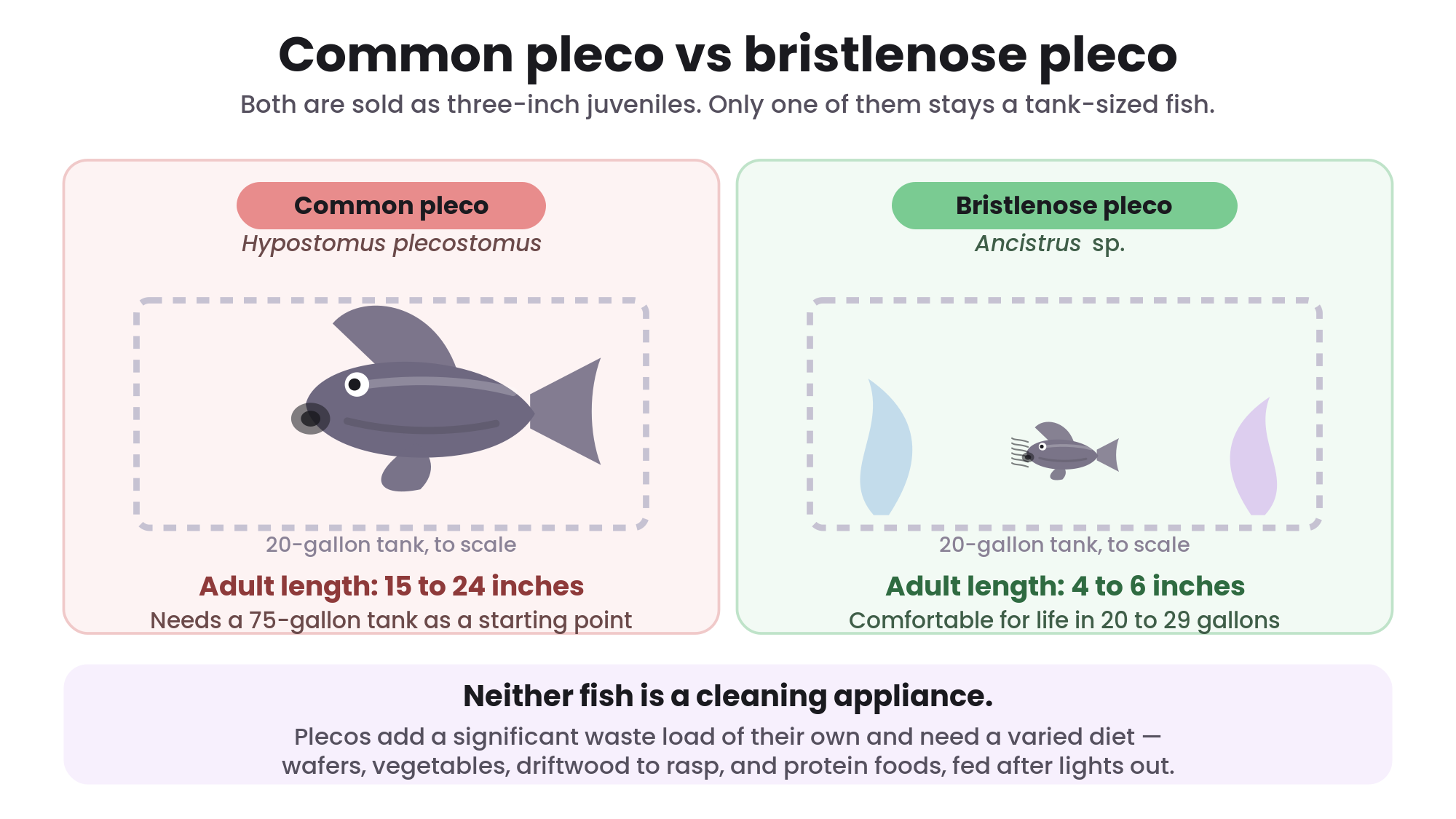
The bristlenose is the pleco a beginner should actually buy, and the distinction from the common pleco is the single most valuable thing in this article. Bristlenose plecos reach four to six inches, live comfortably in a 20 to 29-gallon aquarium, graze algae and biofilm genuinely rather than decoratively, and males develop the branching facial tentacles that give the fish its name.
Minimum tank: 20 to 29 gallons
Temperature: 74–80°F
pH: 6.5–7.8; nitrate kept at or below 40 ppm
Group: fine alone; multiples need more females than males and a cave each
Diet: algae wafers plus vegetables, driftwood to rasp, and protein foods; feed after lights out
Do not buy one expecting a cleaning appliance. Plecos produce a substantial waste load of their own and need a properly varied diet — the classic “one algae wafer a night” approach starves an adult. Buying a bristlenose from a breeder rather than a bin labeled “plecostomus” guarantees you are getting the four-to-six-inch species and not its nearly two-foot cousin.
Angelfish (Pterophyllum scalare)
Angelfish are on this list because they are magnificent, widely available, and entirely keepable by a careful beginner — in the right tank. They are ranked last because that tank is not a first 10-gallon. An adult angelfish is roughly the size of a small saucer — about six inches long and eight inches tall including the fins — and is built vertically, so tank height matters as much as volume. They are also cichlids, with the territorial behavior that implies, particularly once they pair off.
Minimum tank: 29 gallons tall for a single fish or a bonded pair; 55 gallons for a group
Temperature: 76–84°F; Aquarium Co-Op keeps them warmer, at 78–86°F
pH: 6.5–7.5, within the 6.0–8.0 band Aquarium Co-Op reports they tolerate
Group: one, a bonded pair, or a grow-out group of six juveniles. Groups of three or four reliably end with two fish pairing off and bullying the rest.
Diet: quality flake or pellet plus frozen bloodworms and brine shrimp
The standard approach is to buy six juveniles, let them grow out together, and rehome the surplus once a pair forms — which is why the group size recommendation matters before you buy rather than after. Have the rehoming plan ready before you buy rather than after: Aquarium Co-Op’s guidance for a 55-gallon is to start with five or six juveniles and be prepared to remove some later if they get too territorial, and to keep no more than four adult angelfish in a 29-gallon community tank. Angelfish will also eat anything small enough to fit in their mouths, which rules out shrimp and very small tetras as tank mates. If angelfish are what drew you to the hobby, they are a good goal; a 29-gallon tall or larger as the first tank makes them the first fish rather than the second.
Beginner stocking plans by tank size
These are complete combinations rather than menus. Each assumes a cycled, heated, filtered tank and each is stocked conservatively enough to leave room for error.
5 gallons
One betta, heated to 78–80°F, with a sponge filter, live or silk plants, and a cave. Optionally a few Neocaridina shrimp, accepting that some bettas hunt them. This is a complete single-fish display and it is the only stocking plan a 5-gallon tank should be asked to support.
10 gallons
A trio of Endler’s livebearers — one male and two females, which is Aquarium Co-Op’s figure for a 10-gallon — or a small male-only group if you would rather not manage fry. A mixed-sex trio fills the tank on its own, which is why Aquarium Co-Op puts a six-to-nine-fish colony in a 20-gallon rather than a 10. Add a small group of shrimp and a nerite snail for the cleanup that plecos are wrongly credited with. Alternatively, one betta plus six pygmy corydoras — Corydoras pygmaeus, a dwarf species Seriously Fish puts at around 1.2 inches and is happy in a group in a tank of these dimensions, not the bronze or panda corys ranked above, which want 20 gallons — which uses both levels of the tank without crowding either.
20 gallons long
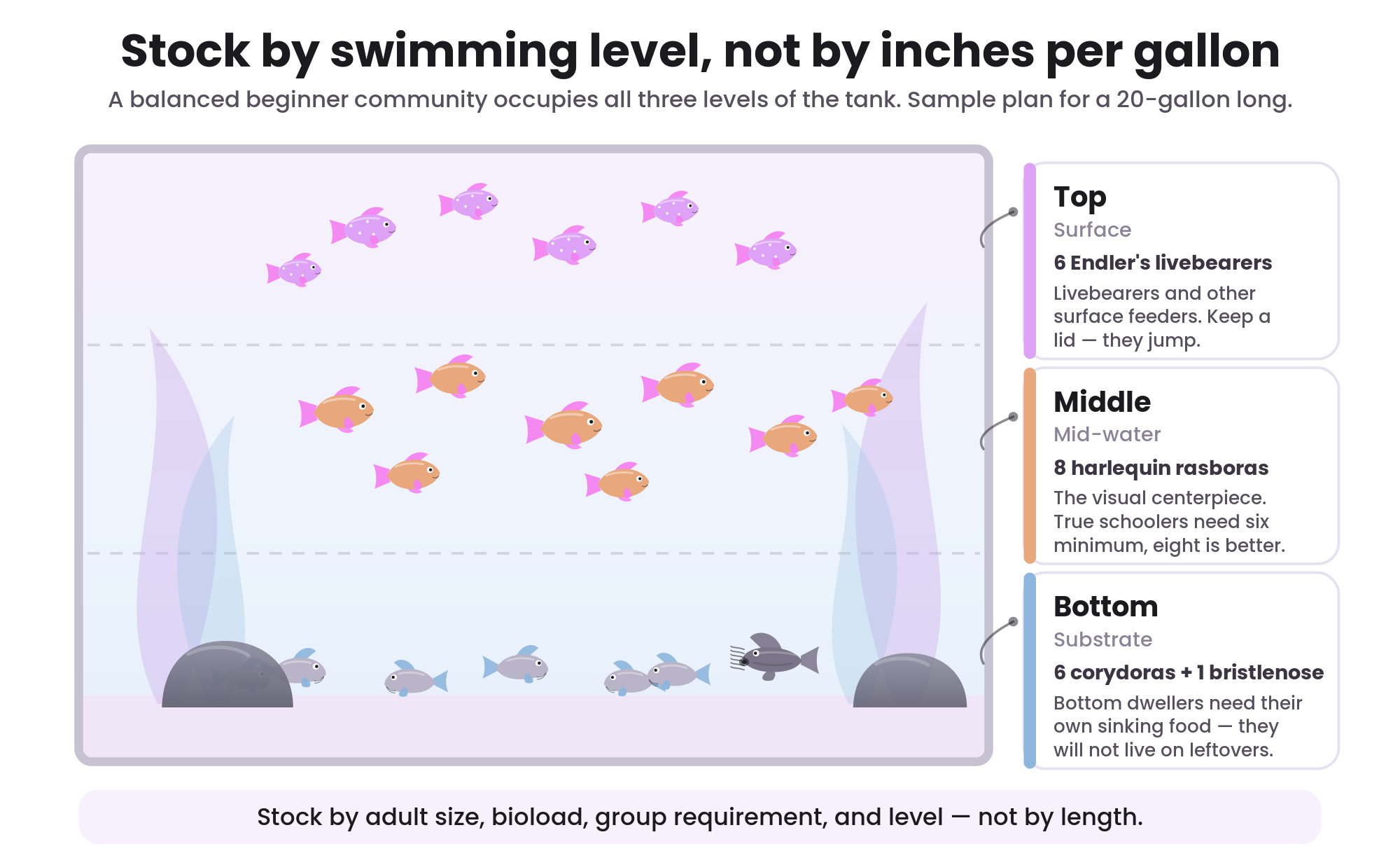
The best all-round first community tank. Eight harlequin rasboras through the middle water, six bronze corydoras along the bottom, and six Endler’s livebearers or guppies near the surface. Every level is occupied, no species is kept below its group minimum, and there is headroom in the bioload. Adding a single bristlenose pleco works if you keep up with water changes.
29 gallons
Everything the 20-long supports, plus a centerpiece. Ten harlequin rasboras, eight corydoras, one bristlenose pleco, and either a single angelfish or a bonded pair in a 29-gallon tall. If you go with angelfish, drop the smallest fish from the plan — anything under an inch is food.
55 gallons and up
Six angelfish grown out together, twelve harlequin rasboras or larger tetras, eight to ten corydoras, and one or two bristlenose plecos. Treat the six angelfish as a grow-out rather than a settled population: Aquarium Co-Op’s guidance for a 55 is to start with five or six juveniles and be prepared to remove some later if they get too territorial, so line up homes before you need them and expect to end with a pair or a carefully managed group. Our guide to how many angelfish to keep together covers the group dynamics in detail. Managed that way it is also, counterintuitively, the easiest tank on this list to keep stable.
Fish to avoid for your first tank
These are not bad animals. They are animals whose requirements are routinely misrepresented at the point of sale, and they account for a large share of first-year failures.
Common pleco (Hypostomus plecostomus) — sold at three inches, reaches roughly 15 to 20 inches (Tropical Fish Hobbyist gives a maximum of 50 cm, or 20 inches), and needs a 75-gallon tank as a starting point with far larger housing as an adult. Nearly impossible to rehome, and a documented invasive: USGS records it as established in Texas — introduced by aquarium release or escape from aquaculture facilities, with suspected local displacement of native algae-feeding fish — and reported from Florida, Nevada and Puerto Rico, though USGS notes the Nevada specimen lot was later identified as an unidentified Hypostomus rather than this species. Buy a bristlenose instead.
Common goldfish (Carassius auratus) — not a tropical fish, reaches 12 to 14 inches, needs around 30 gallons per fish, and eats plants and tank mates. A fine pet in the right setup; a poor fit for a heated community tank.
Bala shark and iridescent shark — both are schooling fish sold as three-inch juveniles for tanks that cannot hold one adult, let alone a group. A bala shark reaches about 14 inches (FishBase gives 35 cm SL). The iridescent shark is in a different league entirely: it is a pangasiid catfish USGS records to 130 cm — roughly 4.3 feet — and it is the same fish farmed and sold as swai.
Tiger barbs with long-finned fish — lively and hardy in a group of six or more, and reliable fin-nippers when housed with bettas, angelfish, or fancy guppies.
Oscars and other large cichlids — intelligent, personable, reaching 10 to 12 inches, and needing 75 gallons or more (Aquarium Co-Op’s recommendation over the 55 gallons sometimes quoted) with filtration sized for a heavy waste producer. Not a first tank.
Neon tetras as the first fish in a new tank — popular and genuinely more sensitive to water quality than the species ranked above. They are a good second purchase once the tank is established.
How to stock a tank without the inch-per-gallon rule
The old “one inch of fish per gallon” guideline persists because it is easy to remember, and it fails because length is a poor proxy for everything that matters. A ten-inch fish is not ecologically equivalent to ten one-inch fish: body mass scales with roughly the cube of length, so the large fish produces vastly more waste, consumes more oxygen, and claims territory that ten small schooling fish never would. The rule also ignores tank shape — a tall, narrow twenty gallons has far less surface area for gas exchange than a shallow, wide twenty gallons — and it invites people to stock by the size of the juveniles in the bag rather than the adults they become.
Four questions replace it.
What is the adult size of every fish, and does the tank’s footprint suit it? Length of tank matters more than gallons for active swimmers.
What is the bioload? Messy eaters and large-bodied fish like plecos and cichlids produce disproportionate waste for their length.
What group size does each species need? A fish that requires six is a purchase of six, not one.
Which level of the tank does each species occupy? Distributing fish across top, middle, and bottom uses the whole aquarium and reduces competition.
How to add your fish
Add one species at a time and wait two to three weeks between additions. Each new group increases the ammonia load, and the bacterial colony needs time to grow into it — adding everything at once is a reliable way to produce a nitrite spike in a tank that had been reading zero. Buy the full group of a schooling species in one purchase rather than adding to it later, so the school establishes together.
If you have a second tank available, quarantine new fish for 30 days before they meet your established community. It is among the most effective disease-prevention measures available to a home aquarist, and it matters most in exactly the situation beginners find themselves in — adding retail fish of unknown history to a tank they cannot easily treat.
Frequently asked questions about the best beginner tropical fish
-
Endler’s livebearers, on the combination of small adult size, wide tolerance for temperature and pH, and an appetite that accepts anything. A trio fits a 10-gallon tank and they are active enough to be interesting all day. Buy from a breeder who raises their own stock rather than from bulk trade supply, since Endler-guppy hybrids circulate in the trade under the Endler’s name and hardiness tracks the source rather than the label on the tank. Zebra danios are a close second and are the better choice if your room runs cool, since they are comfortable from around 64°F upward. Both are considerably more forgiving than neon tetras, which are the fish most beginners buy first.
-
Roughly six to eight small fish under two inches, stocked as a single species group or two small groups occupying different levels. A trio of Endler’s livebearers works — Aquarium Co-Op’s figure for a 10-gallon, with the caveat that they breed and the number climbs on its own — and so does one betta with six pygmy corydoras. What does not work is a mixed handful of one or two individuals of several schooling species, because each of those species needs a group of its own to feel secure. Ignore the inch-per-gallon rule and stock by adult size, group requirement, and how much waste each fish produces.
-
Yes, if you want the fish to live. An uncycled tank has no bacterial colony to convert ammonia, so ammonia and then nitrite accumulate to toxic levels within days of adding fish. A fishless cycle commonly takes four to six weeks from scratch — though published guidance ranges from a few weeks to months — or one to two weeks with seeded filter media or bottled bacteria, and it costs nothing but patience. The tank is cycled when it clears about 2 ppm of ammonia to below roughly 0.2 ppm ammonia and nitrite within 24 hours. If fish are already in the tank, test daily and change 25 to 50 percent of the water whenever ammonia or nitrite exceeds 0.25 ppm.
-
It depends entirely on where they come from. The species is well suited to beginners, but breeders and retailers widely report that decades of line-breeding for color and fin shape combined with mass production in crowded farms have reduced the hardiness of commercially farmed guppies, and that fish frequently reach retail already diseased and part-way through medication. That account is based on hobby and trade experience rather than a published study, so treat it as a strong pattern rather than a measured fact. Guppies from a local or domestic breeder that raises its own stock behave like the hardy beginner fish guppies are supposed to be. If you are buying the cheapest fancy guppies available, expect losses; if you are buying from someone who bred them, expect a good beginner fish.
-
No. Bettas are tropical fish that need water held at 76 to 82°F, and below that range their metabolism slows, immune function declines, and they commonly lose their appetite and become lethargic. The minimum practical tank is 5 gallons with a heater and a gentle filter, because smaller unheated volumes swing in temperature and accumulate ammonia far too quickly to stay safe. The bowl imagery comes from how bettas are merchandised, not from their biology — wild bettas live in vegetated streams, ditches, and rice paddies, not stagnant puddles. In a proper setup a betta commonly lives three to five years.
-
Adult size, and it is not close. The common pleco (Hypostomus plecostomus) is sold as a three-inch juvenile and grows to roughly 15 to 20 inches — Tropical Fish Hobbyist gives 50 cm, or 20 inches, as the maximum — needing a 75-gallon tank as a starting point and far larger housing at full size. The bristlenose pleco (Ancistrus sp.) tops out at four to six inches and is comfortable for life in a 20 to 29-gallon aquarium. Both are algae grazers, but neither is a substitute for maintenance — plecos add a significant waste load of their own and need a varied diet of wafers, vegetables, driftwood, and protein foods rather than a single algae wafer a night.
-
They can be, provided the tank suits them from day one. An adult angelfish reaches the size of a small saucer and is built vertically, so it needs a 29-gallon tall as an absolute minimum for a single fish or a bonded pair, and 55 gallons for a group. They are cichlids and become territorial as they mature, and groups of three or four almost always end with two fish pairing off and harassing the others — keep one, a bonded pair, or a grow-out group of six with homes arranged for the surplus. They will also eat shrimp and very small tetras. As a first fish in a properly sized tall tank, an angelfish is a fine choice; as an addition to a 10-gallon starter tank, it is not.